
Disposable camera photos with your phone
The single-use camera look comes from a plastic lens, a flash with no judgement, and cheap film. Here is how each of those shows up in a photo — and how to get all three on a phone.

Turn the flash on and leave it on, frame at 3:4, stand one to three metres from your subject, and shoot without composing. Then let the camera add the dark corners, the grain and the lifted blacks.
Rumi Cam has two single-use cameras: Disposable for the soft, hazy version with heavy dark corners, and FQS for a punchier, higher-contrast one. Disposable is free.
What a disposable camera actually does to a photo
Single-use cameras are about as simple as a camera can be: a fixed plastic lens, one shutter speed, one aperture, a flash, and a roll of cheap colour film. Every quirk in the photos comes from one of those five things, which is why the look is so consistent and so easy to recognise.
The flash fires on everything
There is no light meter deciding whether flash is needed. You wind it, you press it, it fires — indoors, outdoors, midday, midnight. That produces a brightly lit foreground subject, a background that falls away into darkness, and hard shadows sitting right behind whatever you pointed at. It is the single most recognisable feature of the format.
The corners go dark
A cheap plastic lens cannot deliver light evenly across the frame, so the corners come out noticeably darker than the middle. On a real disposable this is a manufacturing compromise. In practice it frames your subject for you, which is part of why these photos feel warm and snapshot-like rather than clinical.
The grain lives in the shadows
Film grain is not an even layer of noise over the whole picture. It is most visible in the darker parts of the frame and nearly invisible in bright highlights. Filters that sprinkle uniform noise across everything get this wrong, and it is usually the reason a fake film photo reads as fake.
The blacks never go properly black
Cheap film, a plastic lens and decades in a drawer all conspire to lift the darkest tones. Shadows settle into a milky grey-green rather than true black, and there is often a faint haze across the whole image. It is the opposite of the crisp, deep contrast a phone produces by default.
Nothing is quite sharp
Fixed focus means one distance is acceptably sharp and everything else is approximate. There is no zoom, no autofocus, and no second attempt — you got one frame and found out how it went two weeks later.
The two disposable cameras in Rumi Cam
Rumi Cam has two, and they are genuinely different rather than variations on a slider. Both apply their look live in the viewfinder, so you see the flash falloff and the vignette while you are still framing.
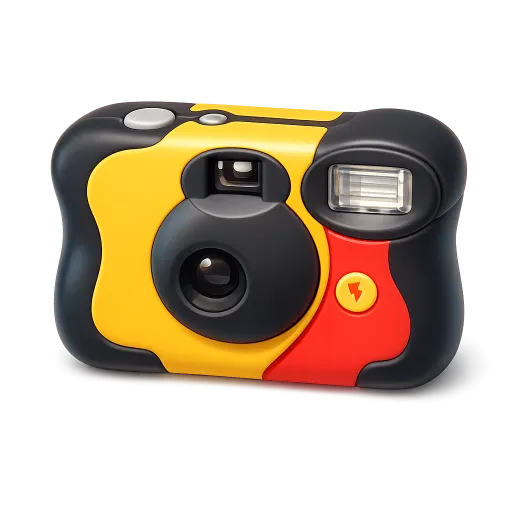 Disposable
Soft, hazy, heavy dark corners. Free.
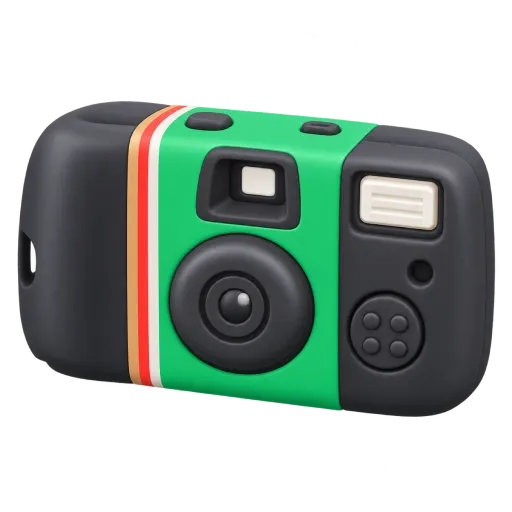 FQS
Punchy, contrasty, grain throughout. Pro.
Disposable — the faded one
This is the closest thing to a used single-use camera found in a drawer. It lifts the whole image, and critically it does not push the shadows down at all — blacks rise into a soft grey, which together with a deliberate haze gives photos a milky, slightly dreamy quality. The vignette is the strongest of the two, so the corners fall away hard. Grain is set to appear in the darker areas only, exactly as film behaves.
Colour-wise it cools skin slightly and lifts skies into a pale, washed-out blue. Detail is softened a little, as a plastic lens would.
Use it for: parties, holidays, anything you want to feel like a memory. It is the more forgiving of the two and the more obviously nostalgic.

FQS — the punchy one
FQS goes the other way. It pushes shadows down while lifting highlights, which gives it the highest contrast of any camera in this pair — noticeably snappier and more saturated in feel. There is no haze and no softening, so photos stay sharper, and the vignette is present but much lighter. Its grain is finer and spread across the entire frame rather than confined to the shadows.
It also pulls warm light sources back hard, which stops indoor tungsten lighting from turning everything orange the way it does on Disposable.
Use it for: daylight, street shooting, anything with strong colour you want to keep. If Disposable feels too washed out for a scene, this is the answer.

Side by side
| Disposable | FQS | |
|---|---|---|
| Contrast | Lifted, low — blacks stay grey | High — shadows pushed down |
| Haze | Yes, noticeable | None |
| Vignette | Strong | Moderate |
| Grain | In the shadows only | Across the whole frame, finer |
| Sharpness | Slightly softened | Unsoftened |
| Feels like | A found photo | A fresh print |
| Included | Free | Pro |
How to shoot it
- Pick your camera. Disposable if you want it faded and dreamy, FQS if you want it punchy. Disposable is free, so start there.
- Turn the flash on. Not auto — on. This is the step people skip, and it is the one that matters most.
- Set the ratio to 3:4. Single-use cameras never shot widescreen.
- Stand one to three metres away. Too close and a real disposable could not focus; too far and the flash cannot reach. Staying in that range is what makes the lighting look right.
- Do not compose. Point at the thing, press the button, move on. Careful framing is the fastest way to break the illusion.
Five shots that always work
The kitchen at a party. Bad overhead lighting, people mid-conversation, flash firing. This is the format's native habitat.
Someone in a car. Passenger seat, window light behind them, flash filling the face. The contrast between the two light sources is exactly what cheap film does badly and memorably.
Daylight with the flash on anyway. Counter-intuitive and extremely effective. It flattens the foreground slightly and gives away instantly that no phone made this decision.
A group squeezed into frame. Too many people, nobody quite ready, corners going dark. Nothing else looks so much like a photo from a shoebox.
The thing you were eating. Shot from above, flash on, no styling. Genuinely unglamorous and all the better for it.
Three things to avoid
Do not edit it afterwards. The look is finished when the shutter fires. Pushing contrast or warmth on top of it makes the photo look processed rather than found.
Do not only shoot in good light. Disposable cameras were used in terrible light constantly, and the results are the whole appeal. A beautifully lit golden-hour photo through a disposable simulation just looks like a slightly worse golden-hour photo.
Do not add a fake date stamp. It has become shorthand for "retro filter" rather than a real signal, and it undercuts a photo that was doing fine on its own. Rumi Cam does not add one.
What it costs
The Disposable camera is one of the six cameras included free, alongside Original, NK, XA, G7X and Fuji. FQS is part of Rumi Cam Pro, which also unlocks the other seven cameras, every film roll, the lens accessories including Lens Leak, and photo editing. Pro is available monthly, yearly or as a one-off lifetime purchase.
If you want the leaks and streaks people associate with old prints, that is the Lens Leak accessory rather than the camera itself — ten variants with a shuffle button so your shots do not all carry the same overlay.
The Disposable camera is free
No film to buy, no two-week wait, and you can see the shot before you take it.


Frequently asked questions
What makes a photo look like a disposable camera shot?
A hard flash on every frame, dark corners from the plastic lens, grain sitting in the shadows, blacks that lift into a milky haze, and soft fixed-focus detail. The flash and the vignette do most of the work.
What is the difference between Disposable and FQS?
Disposable is softer: hazy, lifted blacks, strong vignette, grain only in the shadows. FQS is punchier: more contrast, no haze, sharper, lighter vignette, and finer grain across the whole frame. Disposable is free, FQS is Pro.
Is there a free disposable camera app?
Yes. Rumi Cam is free to download on iPhone and Android, and the Disposable camera is included at no cost.
Should I use flash during the day?
Yes. A real single-use camera has nothing deciding when to fire, so it goes off in daylight too. Forcing it on outdoors is one of the most effective things you can do.
Do I need to edit afterwards?
No. The look is applied live before the shutter fires, so the photo is done when you take it. Editing on top tends to make it look more processed, not more authentic.
Does it work for video?
Yes. Switch to video mode and the camera applies the same way. For a camcorder look specifically, the HC camera is built for it.